— Marketplace development

Multi-vendor marketplace
development, end to end.

We build marketplaces for operators running many sellers on one storefront — catalogue, commission rules, split fulfilment, and a payout ledger where every line reconciles to the orders behind it.

Built for the World Bank in Jordan, where one Arabic B2B marketplace carried about 1,500 businesses.

If you have fewer than twenty sellers, we will tell you on the call that you do not need this yet.

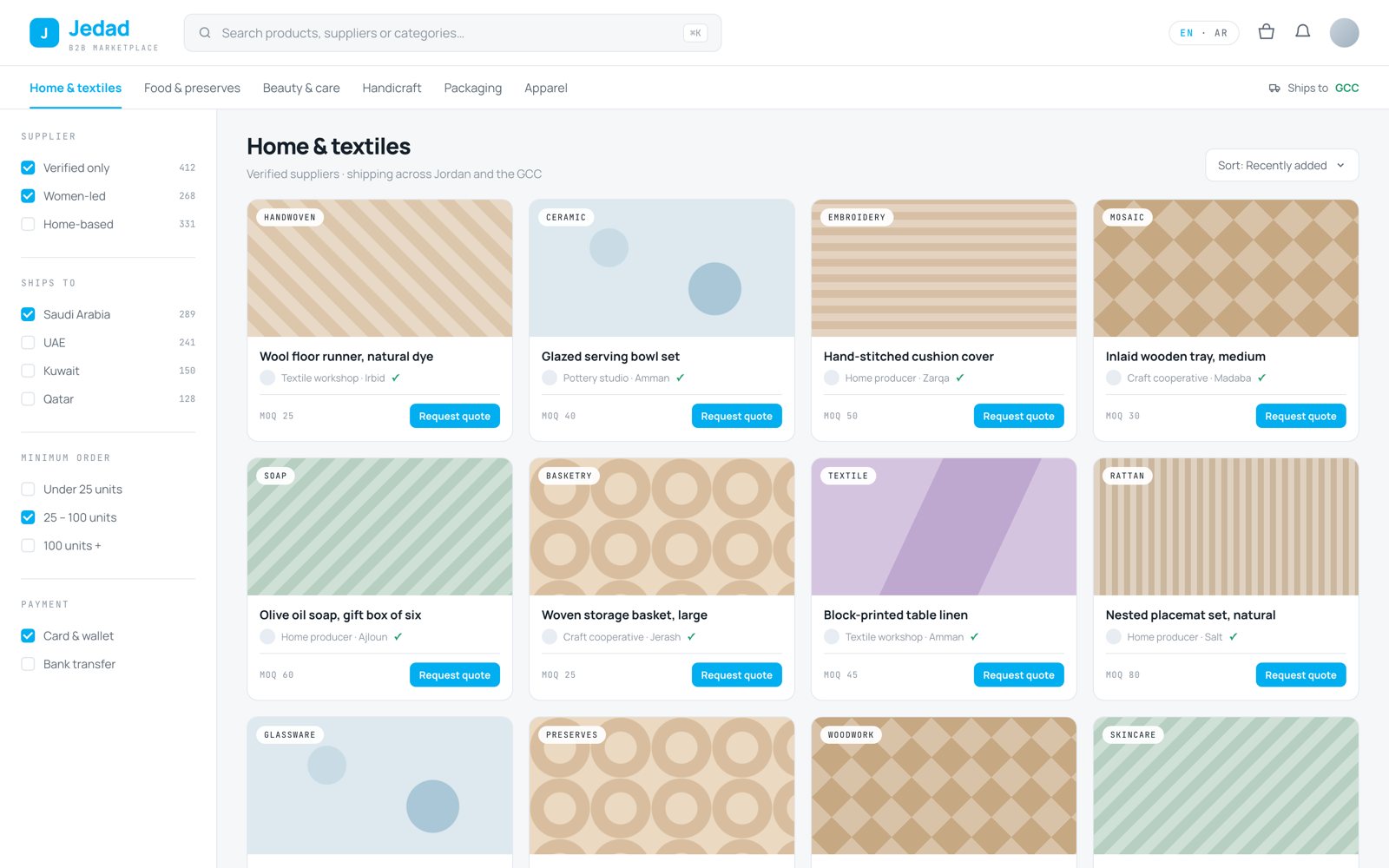
The Jedad B2B marketplace catalogue, showing producer listings across nine product categories
Reconstruction for illustration — rebuilt from the original design files rather than a capture of the live platform. The programme ended in 2024 and the storefront is no longer served.
$0Per vendor, per month. Sellers cost you nothing to add
100%Of the code and the commission rules are yours to change
ReconciledEvery payout traceable to the orders behind it, to the line
3yrsCode guaranteed after launch, defects and security

What the engagement gives you. Programme scale — sellers onboarded, demand generated, months on the ground — sits with the client work in section 13.

— What went wrong before

The software was never
the hard part.

Three ways an operator ends up running a marketplace out of a spreadsheet. You have probably lived one of them.

  1. The rented platform

    A per-vendor licence that made sense at twelve sellers and does not at two hundred. The commission model is whatever the vendor decided, the payout report is whatever they export, and the answer to "can it split a payment three ways" sits on their roadmap while you wait.

  2. The plugin on a shop

    A single-seller store with a multi-vendor extension bolted to it. It lists fine. It falls over at the money: refunds that do not claw back commission, a seller who ships half an order, a payout run that nobody can reconcile against the bank.

  3. The spreadsheet that never left

    The platform handles orders and a person handles money. Every month someone exports, matches, adjusts and pays by hand — and the marketplace cannot grow past the number of rows that person can check.

All three end the same way. The catalogue looks like a marketplace and the back office is still one person with a deadline.

— The trigger

It launches fine.
It breaks on payout day.

Nobody replatforms a marketplace because listing is hard. They replatform because the end of the month has become a two-day job with a dispute at the end of it.

A refund goes out and the commission stays gone

The buyer is refunded, the seller's balance is not adjusted, and the difference is found weeks later by someone reading a bank statement.

One order, three sellers, one delivery fee

A basket spanning three vendors has to split into three fulfilments, three commissions and one shipping charge that somebody has to absorb. Most platforms model the first and guess the rest.

A seller asks why they were paid that

If the answer takes more than one click, the marketplace has a trust problem rather than a software problem — and trust is the only thing keeping the sellers on it.

— Then the invoice

You pay per seller,
forever.

The fee scales with the thing you want to grow

Hosted marketplace platforms price per vendor per month. Recruiting sellers is the whole job, and every one you win raises the bill before they have sold anything.

Commission logic sits behind a plan

Category rates, introductory rates, a different split for a strategic seller — the rules that make a marketplace viable are usually the ones held back for the top tier.

Your sellers are on their terms

Vendor accounts, payout schedules and dispute flows belong to the platform. If you leave, the relationship you spent two years building is the part that does not export.

— This market

Most of your sellers
have never had a bank payout.

A marketplace designed in California assumes every vendor has a company, a bank account and a card on file. Across Jordan and the Gulf a large share of the sellers worth having are individuals and home businesses, and the platform has to meet them where they are.

  • Cash on delivery has to survive the split

    Around 70% of consumers in the region still prefer to pay the driver. On a single-seller store that is a reconciliation problem. On a marketplace it is three: the courier holds the cash, the commission is owed, and the seller is waiting. The model has to carry it rather than treat it as an exception.

  • Sellers in places without addresses

    Pickup from a producer working out of a home in a neighbourhood with no street numbering is the normal case here. Collection is resolved per city, against a courier who is actually paid.

  • A seller console in the seller's language

    The buyer-facing storefront being bilingual is table stakes. The part that decides whether a seller stays is whether they can read their own order list, and that console mirrors rather than translates.

  • Onboarding that finishes on a phone

    A seller signs up, uploads a product and photographs it on the same device, standing in their workshop. If onboarding assumes a desktop and a scanner, the sellers you most want never finish it.

Crocheted toys brought to a design mentoring session.
Crocheted toys brought to a design mentoring session. Every seller on Jedad was a producer like this — the platform had to be usable by them as well as by the buyers.
— The question everyone asks second

“What if the sellers don't come?”

The honest objection to building rather than renting. Here is our answer, in writing.

  • Supply first, and we will say so. A marketplace with no sellers is a website. If you do not have a route to the first fifty, the build is premature and we will tell you that on the call rather than after the invoice.
  • You own the code and the rules. Commission, payout schedule, category rates — yours, in your repository, changeable without asking anyone.
  • The stack is standard, and deliberately so. Next.js and PostgreSQL. Any competent agency can pick it up.
  • You pay as it is proven. Invoiced phase by phase, each signed off against agreed acceptance criteria before the next is billed.
— The guarantee

We guarantee the code for three years.

If something we built stops working the way it was specified, we fix it. No support contract required, no hourly rate, no argument about whose fault it is.

What it covers
Defects in the code we wrote, security patches to our own code, and keeping the build running against dependency updates.
What it does not
New features, changes to what was agreed, or third-party services failing on their side.

The guarantee lapses on code modified by a third party — the trade for owning it outright.

A marketplace with no sellers is a website. Supply is the product; the software is how you keep it.
Why we lead with this. Every marketplace that failed in this region failed on supply long before it failed on features. An agency that sells you the build without asking about the sellers is selling you the easy half.
— What we build

The half that isn't
the catalogue.

Every line below ran on Jedad. Listing products is the part every platform does; these are the parts that decide whether the marketplace still works in year two.

Commission that varies by whatever you need it toPer category, per seller, per campaign — and changeable by you, in an afternoon.
Payout runs that reconcile to the lineEach payment traceable to its orders, its commission and its refunds, exportable in the format the bank wants.
Split baskets and split fulfilmentOne order across three sellers becomes three fulfilments, three commissions and one delivery charge with a stated owner.
Seller onboarding with an approval stepDocuments, categories and a review queue — because a marketplace is only as good as what you let onto it.
A seller console that answers "why was I paid that"Orders, deductions and the running balance, in the seller's own language, in one screen.
Search across sellers, not within oneTypo-tolerant in Arabic and English, ranking by relevance rather than by whoever uploaded most recently.
Dispute and refund flows that adjust the moneyA refund claws back the commission automatically. Nobody finds the difference in a bank statement six weeks later.
Category structures that survive 1,500 sellersNine categories on Jedad, each with its own attributes — so a prayer rug and a jar of preserves are not described by the same six fields.
— The differentiator

One ledger, and every
number on it has a reason.

Most multi-vendor systems calculate the payout at the end of the month, from the orders that happen to be in the right state. We write a ledger entry the moment anything moves. The month-end figure is then a sum of entries that already exist, and every line can be opened.

  1. The order is placed

    Three ledger entries rather than one: what the buyer owes, what the seller is due, what the commission takes. Written together so they cannot disagree.

  2. The courier collects the cash

    Cash on delivery means the money exists before it reaches you. The entry moves from due to held, against the courier, with the date it was collected.

  3. Half the order comes back

    The refund writes its own reversing entries — buyer, seller and commission — rather than adjusting the originals. Nothing is edited, so nothing is lost.

  4. The payout runs

    Sum the seller's entries for the period. That is the payment. When they ask why, the answer is the list of entries that made it.

A payout you cannot explain to the seller is a dispute you have not had yet.
Why this is the section that matters. Catalogue, search and checkout are solved problems with a dozen vendors each. The ledger is where marketplaces built on a shop plugin come apart, and it is the part that cannot be retrofitted once there is real money in it.
— Try it

What a payout run
actually looks like.

Move the sliders. This is the same arithmetic the ledger performs, including the part most platforms get wrong — a refund clawing back its commission.

Payout breakdown for one seller
Gross sales12,000.000
Less returns−960.000
Net sales11,040.000
Commission 12%−1,324.800
Commission returned on refunds+115.200
Seller is paid9,830.400

8,400.000 JOD of this sits with the courier until cash on delivery is banked. On a rented platform that line usually does not exist, and the payout goes out before the money arrives.

Illustrative arithmetic on figures you choose. Jordanian dinars to three decimal places, as the currency is actually quoted.

— Who builds it

Two founders.
Not a sales team and a queue.

The people you meet on the call are the people who do the work.

Noora Shanak, Co-founder and COO of Umbrella500

Noora Shanak

Co-founder & COO · Project lead

Twenty years as a consultant and e-commerce specialist. Co-founder and COO of ShopGo, where she helped more than 1,000 MENA businesses scale online — many past $100K a month. She leads the technology practice.

  • 1,000+ businesses scaled
  • $100K+/mo merchants
  • 20+ years in e-commerce
Saleem Najjar, Co-founder and CEO of Umbrella500

Saleem Najjar

Co-founder & CEO

Co-founder of ShopGo.me, acquired, which helped more than 1,000 MENA entrepreneurs launch online stores. He has since supported over 13,000 entrepreneurs across the region, and led the Jedad programme delivery on the ground.

  • 13,000+ entrepreneurs supported
  • ShopGo · acquired exit
  • Jedad programme lead
— The alternatives

Four ways to run a marketplace.
One of them is not us.

Published 2026 pricing, cited underneath. Where a figure is a range we quote the bottom of theirs and the top of ours.

Sharetribe

The fastest way to find out if anyone wants it.

Hosted, launch in days, no developer needed. Fixed commission model and limited control over checkout and payout logic. Priced per month with transaction fees on top, rising with volume.

Choose it if: you are testing whether the supply exists and expect to rebuild once you know.

Marketplacer / Mirakl

Enterprise, and priced for enterprise.

Genuinely capable operator tooling and seller management. Licences run well into six figures annually before implementation, and both are sold on annual contracts with an integration partner attached.

Choose it if: you are a large retailer adding a marketplace to an existing chain, with a team to run it.

A multi-vendor plugin

Cheap until the money moves.

A single-seller store with vendors bolted on. Fine for listings and for a dozen sellers. The failure mode is always the same and always at the ledger — partial refunds, split baskets, cash on delivery, and payouts nobody can reconcile.

Choose it if: you have under twenty sellers and simple, prepaid, single-vendor orders.

A custom build

Costs more on day one. Costs nothing per seller, ever.

You own the commission rules, the payout logic and the seller relationship. No per-vendor fee, so recruiting sellers stops raising the bill. It takes months rather than days, and it only makes sense once supply is real.

Choose it if: you have sellers waiting, the money model is not standard, and you intend to be trading in five years.
If you cannot yet name fifty sellers who would list tomorrow, Sharetribe is the right answer and we will say so on the call. Supply is the product; we would rather you prove it cheaply than pay us to find out.

— How we work

The ledger is built first,
because it is the risk.

Riskiest part first, proven running, before the rest of the budget is committed. On a marketplace that is never the catalogue.

  1. Phase 1

    The money model, on paper

    Commission, refunds, cash on delivery, split baskets and who absorbs the delivery fee — agreed in writing before any code. Most of the argument happens here, which is where it is cheapest.

  2. Phase 2

    The ledger, running

    Entries, reversals and a payout run you can execute against test data. Demonstrated to you before anything else is built.

  3. Phase 3

    Seller onboarding and the console

    Sign-up, approval queue, listing, and the screen that answers "why was I paid that". Ten real sellers on it before the storefront is finished.

  4. Phase 4

    The storefront and search

    Buyer-facing catalogue, bilingual, with search across sellers. The part every platform does, done last because it is the least risky.

  5. Phase 5

    A payout run against real money

    One live cycle, reconciled to the bank with you in the room, before we call it launched.

— The marketplace we built

Jedad — a B2B marketplace
for 1,500 producers.

Built for The World Bank in Jordan. Home businesses and small producers — the sellers who had never had a payout — listing to buyers across the Gulf. Nine product categories, each with its own attributes, each needing its own guidance before a single item was fit to sell.

1,500Businesses digitised and selling online
$200KPotential demand generated in the GCC market
JD 217KB2B price offers sent through the platform
6,214Customer clicks on beneficiary products

From Umbrella500_Canonical_Numbers.md — figures as published in the World Bank report Jedad: Creating Market Opportunities for Refugee and Host Community Businesses in Jordan (2020), of which our co-founder Saleem Najjar is a named co-author. Third-party published, so they need no substantiation from us.

The marketplace was half the work. The other half was making 1,500 producers ready to be on it — which is why the pictures below are of design sessions rather than dashboards.

Every image above is from the programme itself. Read the full case study

We also built the SPARK Innovation Hub — 500+ organisations, launched in six weeks. Both clients are organisations, and both engagements were product builds delivered to commercial standards. More commercial work sits under NDA.

— Questions

The ones that decide it.

How many sellers do we need before this makes sense?

Enough that a per-vendor licence hurts, and enough that the money model is not standard. In practice that is somewhere past twenty active sellers with real order volume. Below that, a hosted platform is cheaper and faster and we will say so.

Who owns the relationship with the sellers?

You do, including their accounts, their data and their payout history. It is your database. That is the difference between building and renting, and it is the thing that does not export when you leave a hosted platform.

Can it handle cash on delivery across multiple sellers?

Yes, and it is the reason the ledger exists. Cash collected by a courier is money that exists before it reaches you, so it is held against the courier and only released to the seller once banked. Platforms that treat cash on delivery as a payment method rather than a state get this wrong.

What happens when a seller disputes a payout?

They open their console and see the entries that made the number — orders, commission, refunds, and what is still held. Most disputes stop there. The ones that do not have an audit trail behind them rather than a spreadsheet.

How long does a marketplace build take?

Longer than a storefront, and we will give you a range against your money model rather than a number on a page. The phases are in section thirteen and each is signed off before the next is billed, so you can stop after the ledger if the answer changes.

Do you help recruit the sellers?

We have done it — 1,500 producers onboarded on Jedad, which was as much fieldwork as software. It is a separate engagement from the build and we will be explicit about which one you are buying.

— The brief

A marketplace you own,
priced once.

Tell us who your sellers are and how the money is meant to move. Thirty minutes, no cost, and we will say so if a hosted platform is the right answer this year.

Or write directly: [email protected]

Opens your mail app with the details filled in. Nothing is stored on this page.